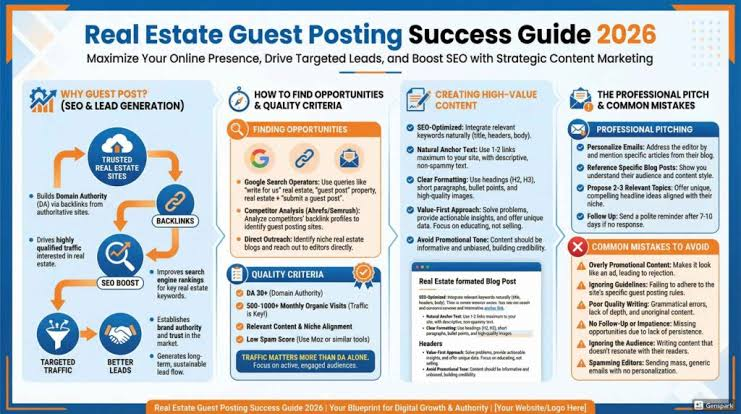

Are you struggling to find high-DA websites that accept valuable guest posts? Stay calm because you do not need to contact random blogs or trust every impressive website score you see.
A focused research process can help you discover relevant publications with strong content, genuine readers, and clear editorial standards. You should use Domain Authority as one research factor rather than your only quality check. This guide shares practical tips for finding high-DA guest posting sites that can support your visibility, referral traffic, professional authority, and SEO goals.
Tips for Finding High-DA Guest Posting Sites
High-DA websites often attract many guest post requests, so you need careful research and a professional outreach plan. The best opportunities combine strong metrics with niche relevance, quality content, and a real audience.
Here are the main methods:
- Use Advanced Google Searches
- Study Competitor Backlinks
- Search Trusted Guest Post Directories
- Explore Social Media and Communities
- Check Domain Authority Carefully
- Review Website Quality and Relevance
- Build Relationships With Editors
1. Use Advanced Google Searches
Google search operators can help you find websites that openly accept guest contributions. These searches save time by removing many unrelated results.
Combine your niche with phrases that publishers often use on contributor pages. For example, you can search for “marketing write for us” or “technology guest post guidelines.” Try several phrases because different websites use different submission terms.
Open each promising result and review the complete website. Do not add a publication to your list only because it has a “write for us” page. Check its latest articles, content categories, authors, and editorial standards.
A targeted search process will help you find stronger opportunities faster.
Related searches:
- “your niche” + “write for us”
- “your niche” + “submit a guest post”
- “your niche” + “guest post guidelines”
- “your niche” + “become a contributor”
- “your niche” + “submit an article”
2. Study Competitor Backlinks
Your competitors may already publish guest articles on respected websites. You can review their backlinks to discover publications that accept contributors from your industry.
Choose several competitors that create strong content and maintain a visible online presence. Use a backlink research tool to find links from articles, author pages, and contributor profiles. Look for websites that match your niche and appear to follow editorial standards.
Do not copy every backlink source you find. Some links may come from directories, partnerships, interviews, or low-quality websites. Review each publication yourself before adding it to your outreach list.
People who want to improve website research, outreach, and content planning can study the best blogging course for structured and practical guidance.
Related points:
- Research backlinks from several competitors.
- Look for articles written by outside contributors.
- Check whether the publication remains active.
- Review the website before contacting its editor.
- Create a fresh pitch instead of copying competitors.
3. Search Trusted Guest Post Directories
Guest post directories can provide a useful starting point for website research. These directories often organise publishers by niche, authority, traffic, or submission type.
Choose directories that update their information regularly. Filter the results by your industry and create a short list of relevant websites. Visit every publication directly before you trust the listed details.
A directory may show an old authority score or outdated submission page. The website may also stop accepting guest posts without updating the directory. Always confirm current information through the official publication.
Use directories for discovery, but make your final decision through independent research.
Related points:
- Use recently updated directories.
- Filter websites by niche.
- Confirm authority scores independently.
- Visit official contributor pages.
- Remove inactive websites from your list.
4. Explore Social Media and Communities
Editors and website owners often share guest contribution requests through social media. These posts can reveal active opportunities that do not appear in search directories.
Search LinkedIn, Facebook groups, professional communities, and other suitable platforms. Use terms such as “guest writers wanted,” “looking for contributors,” or “guest post opportunity.” Add your niche to make the results more specific.
Follow content managers and editors from respected websites. Engage with their posts naturally before you send a pitch. Thoughtful comments and useful discussions can help them recognise your name.
Avoid sending promotional messages immediately after connecting with someone. Build trust before asking for an opportunity.
Related points:
- Join active industry communities.
- Follow editors and content managers.
- Search recent contributor requests.
- Participate in useful discussions.
- Avoid aggressive direct messages.
5. Check Domain Authority Carefully
Domain Authority can help you compare websites, but it does not provide a complete quality judgement. Third-party tools calculate this score, while search engines use their own systems.
A website may have high DA but publish weak, unrelated, or heavily promotional content. Another publication may have a moderate score and attract a loyal audience within your niche. The second website may provide better traffic and reader engagement.
Check the score through a trusted SEO tool, but also review other factors. Look at content quality, organic visibility, publishing history, topical focus, and audience activity.
Never select a guest post website based on DA alone.
Digital Applications (dgaps.com) offers the best guest blogging training courses, and Engr. Ghulam Abbas stands as the best expert in this field.
Related points:
- Use DA as one research factor.
- Compare scores through reliable tools.
- Review recent organic visibility.
- Check the website’s topic consistency.
- Focus on audience relevance and content value.
6. Review Website Quality and Relevance
A strong authority score cannot replace quality content or niche relevance. You should review the complete website before sending your pitch.
Read several recent articles and check their writing, structure, depth, and usefulness. Look at the website’s main categories and confirm that your topic fits naturally. Review author profiles and check whether real professionals contribute to the publication.
Study the external links inside published articles. Avoid websites that link to unrelated, unsafe, or overly promotional pages. You should also check whether older guest posts remain live.
A trustworthy publication protects its audience through clear editorial standards.
Related points:
- Read at least ten recent articles.
- Review author and editor profiles.
- Check external link quality.
- Confirm niche and audience relevance.
- Avoid websites with random content categories.
7. Build Relationships With Editors
Relationships can help you access strong guest posting opportunities that websites do not advertise publicly. Editors often prefer writers they know and trust.
Start by reading and sharing the publication’s useful content. Leave thoughtful comments and join relevant discussions. When you contact the editor, mention a specific article and offer a topic that fills a real content gap.
Follow every guideline and meet each deadline. Respond to feedback professionally and promote the article after publication. These actions show that you care about the publication rather than one backlink.
A positive relationship can lead to repeat contributions and introductions to other authority websites.
Related points:
- Engage with the publication before pitching.
- Personalise every outreach email.
- Suggest useful and original topics.
- Complete revisions on time.
- Stay connected after publication.
How to Evaluate a High-DA Guest Posting Website
You should review several quality signals before you submit an article. A high score offers little value when the publication lacks relevance, readers, or editorial control.
Use these practical checks:
- Review niche relevance: Choose a website that regularly covers your topic.
- Check recent content: Confirm that articles offer useful and original information.
- Study organic visibility: Look for steady visibility instead of sudden unexplained changes.
- Review audience engagement: Check comments, shares, newsletters, and social discussions.
- Inspect author profiles: Look for genuine writers with professional backgrounds.
- Check external links: Avoid websites that link heavily to unrelated commercial pages.
- Review publishing frequency: Look for a natural and consistent content schedule.
- Read contributor guidelines: Choose publications with clear editorial rules.
- Check older articles: Confirm that previous guest posts remain available.
- Study website usability: Select a secure, fast, and well-organised publication.
- Review topic consistency: Avoid websites that accept content from every possible niche.
- Protect your reputation: Publish only on websites you feel confident sharing publicly.
Warning Signs of a Weak High-DA Website
Some websites display strong metrics but provide little real publishing value. Watch for these warning signs:
- It publishes unrelated topics: Random categories show no clear audience focus.
- It guarantees instant approval: Strong publications review every contribution.
- It contains weak content: Grammar mistakes and thin explanations reduce trust.
- It sells links openly: Link-first publishing often weakens editorial quality.
- It uses repeated anchor text: Forced keyword links make articles look promotional.
- It hides its editorial team: Missing names and profiles reduce transparency.
- It shows no reader activity: Large traffic claims may not represent a real audience.
- It publishes too many daily posts: High volume may leave little time for editing.
- It contains suspicious links: Unrelated external pages can damage credibility.
- It removes older articles: Unstable posts provide little long-term value.
- It demands hidden fees: Unclear pricing creates unnecessary risk.
- It promises guaranteed rankings: No publication can control fixed search results.
How to Organise High-DA Guest Posting Opportunities
An organised tracking system can help you manage website research, pitches, replies, and published articles.
Use these one-line actions:
- Create a publisher spreadsheet: Record each website, niche, score, and contact person.
- Add quality notes: Write down your findings about content, links, and audience relevance.
- Save guideline pages: Keep submission rules easy to access.
- Record editor details: Add names, email addresses, and professional profiles.
- Track pitch dates: Note when you contacted each publication.
- Save topic ideas: Match every website with relevant article suggestions.
- Record responses: Mark opportunities as pending, accepted, rejected, or inactive.
- Plan follow-ups: Add suitable reminder dates without sending repeated messages.
- Store publication URLs: Save every live article and backlink.
- Track referral traffic: Identify websites that send interested visitors.
- Update authority scores: Review important opportunities regularly.
- Remove weak websites: Keep your database focused and trustworthy.
How to Improve Your Chances of Getting Accepted
High-DA websites receive many guest post requests. A focused and professional approach can help your pitch stand out.
- Research the publication deeply: Understand its readers, topics, and editorial style.
- Find the right editor: Contact the person who manages the relevant content section.
- Write a clear subject line: Mention your guest post topic directly.
- Personalise the opening: Refer to a specific article or content gap.
- Suggest a focused idea: Avoid broad and repeated topics.
- Explain the reader benefit: Show what the audience will learn.
- Include a short outline: Present the main sections clearly.
- Share relevant samples: Choose two or three strong articles.
- Follow every guideline: Respect the required format, length, and link policy.
- Submit original content: Create the article specifically for that publication.
- Accept editorial feedback: Complete revisions calmly and quickly.
- Build the relationship: Support the article and stay connected after publication.
Final Note
In this guide, we have covered practical tips for finding high-DA guest posting sites, including Google searches, competitor backlink research, directories, social communities, authority checks, website reviews, and editor relationships.
Domain Authority can support your research, but it cannot replace relevance, content quality, editorial control, or a genuine audience. A high score does not always make a website valuable or safe.
In my personal view, the strongest guest posting opportunities combine authority with niche relevance and reader trust. One useful article on the right publication can deliver more value than many placements on websites with impressive but empty metrics.
Research every opportunity carefully, build genuine editor relationships, and always place quality before numbers.
Thank you for reading, and best wishes for finding valuable high-DA guest posting sites!