The Grid Stores Nothing. Everything You Use Was Generated a Heartbeat Ago.
Electricity feels like a utility that flows from a reservoir, but the truth is stranger and more delicate: the grid holds almost no inventory. The power running your lights right now was generated a fraction of a second ago at a plant that anticipated your demand — and if generation and consumption drift apart by more than a whisper, the entire system’s frequency begins to slide and machinery across a continent feels it. Understanding how the electricity grid works means understanding a continuous, high-speed balancing act performed at continental scale: generators of a dozen kinds feeding high-voltage transmission lines, substations stepping power down through distribution networks to your street, and control rooms that forecast, dispatch, and correct every second of every day — plus the markets that decide which power station runs and the physics that decides what happens when the balance fails. This guide walks the chain from power station to plug: the three-layer structure of the network, the frequency signal that acts as the grid’s heartbeat and speedometer in one, the balancing toolkit from spinning reserves to batteries and demand response, and why the renewable transition — millions of small generators like the rooftop systems in our guide to how solar panels work — is rewriting an architecture designed for a few hundred large ones.
Generation, Transmission, Distribution: The Three Layers
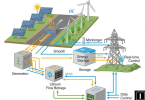
The grid’s geography is a tree. At the trunk sit the generators: power stations of every technology — gas, coal, nuclear, hydro, wind and solar farms — each feeding its output into a step-up transformer that raises the voltage enormously, because voltage is the grid’s answer to distance: the higher the voltage, the lower the current for the same power, and the less energy bleeds away as heat in the wires. That is the transmission network — the motorway system of thick cables on tall pylons (or buried and undersea links) running at hundreds of thousands of volts, moving bulk power between regions and across borders through interconnections that let one country’s windy night supply another’s calm morning. At regional substations, transformers step the voltage down in stages, and the distribution network — the local roads of the system, down to the pole transformer on your street — delivers power at the few hundred volts your home is wired for. Throughout, alternating current rules for a historical reason that remains practical: transformers need it, and the grid is fundamentally a machine made of transformers. Control is layered to match: national or regional system operators run transmission and the overall balance, distribution companies maintain the local network, and retailers handle the billing relationship — three jobs that a single old utility once did alone, now unbundled in most markets so that generation and retail can compete while the wires, a natural monopoly, stay regulated.
Frequency: The Heartbeat That Must Not Drift
The balance has a gauge, and it is elegant: the grid’s frequency — 50 Hz in most of the world, 60 Hz in North America and parts of Asia. Generators across the entire synchronous system are locked into rotating at exactly the speed that produces that frequency, and the frequency itself reports the balance in real time: demand exceeding generation acts as a brake on every spinning machine and the frequency sags; generation exceeding demand releases the brake and frequency rises. The tolerances are tight — operators hold frequency within a fraction of a hertz — because sustained deviation damages equipment and, past protective thresholds, triggers automatic disconnections that can turn a slide into a collapse. Holding it is a continuous act of dispatch: forecasts built from weather, calendars, and live telemetry predict demand minute by minute (the system knows about television-ad-break kettle surges and plans for them), generators are scheduled and re-dispatched against those forecasts in markets that clear from day-ahead down to minutes-before, and layered reserves stand ready for error and accident — fast reserves that respond in seconds (batteries now win these auctions against gas), spinning reserves of part-loaded plants, and demand-side response that pays large users to pause. The nightmare scenario the whole apparatus exists to prevent is the cascade: a major line or plant trips, its load shifts to neighbours, which overload and trip in turn, and a regional fault unzips into a blackout in seconds — the reason operators run the network with deliberate spare capacity, so the loss of the single largest component is always survivable by design.
The Transition: From a Few Hundred Generators to Millions
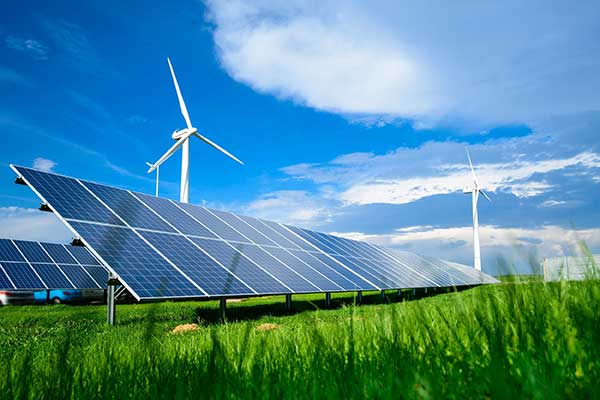
The architecture described above was built for a one-way, top-down world, and the energy transition is inverting it. Rooftop solar, community wind, and batteries turn consumers into producers and the distribution network into a two-way system it was never designed to be; solar’s collective midday surge and evening fade (the famous “duck curve”) move the balancing problem from a gentle daily wave to a steep daily cliff; and inertia — the physical momentum of huge spinning turbines that once stabilised frequency automatically — declines as inverter-based renewables replace rotating machines, so stability must increasingly be synthesised by fast electronics and grid-forming batteries instead. None of this makes the renewable grid impossible; it makes it a different engineering discipline, one being built in real time: smarter distribution networks that monitor and switch at street level, markets that pay for flexibility by the minute, interconnectors that smooth weather across regions, storage at every scale, and pricing that nudges demand toward abundance — the EV charging at noon, the water heated when the wind blows. The core miracle remains untouched and underappreciated: a machine the size of a continent, with no warehouse and no pause button, matching supply to demand second by second through earthquakes, heatwaves, cup finals, and dawns. When you next flip a switch, the click completes a negotiation between a power station, a control room, a market, and fifty million strangers — settled in your favour, in less than a second, for a few cents. That it almost always works is the most ordinary engineering triumph of the modern world.