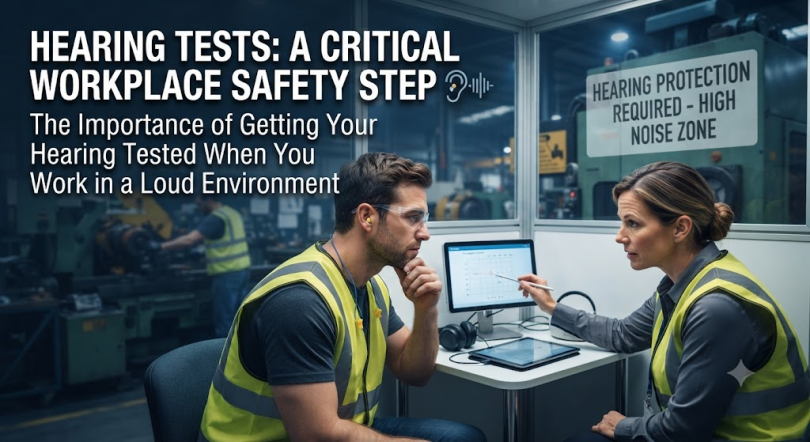

Working around loud machinery, power tools, construction equipment, engines, industrial processes or amplified sound can gradually affect your hearing. The damage may happen so slowly that you do not notice it during an ordinary workday. By the time conversations begin sounding unclear or you find yourself turning up the television, some hearing loss may already be permanent.
Regular hearing tests are therefore an important part of workplace health and safety. They establish how well you currently hear, identify changes over time and help determine whether the hearing protection and noise-control measures being used at work are effective.
Workplace Hearing Loss Can Develop Gradually
Noise-induced hearing loss is not always caused by one extremely loud incident. It can also develop through repeated exposure to excessive noise over months or years.
The risk depends on both the sound level and how long you are exposed to it. In most Canadian jurisdictions, occupational noise limits are based around an eight-hour exposure of 85 dBA, although the exact requirements vary by jurisdiction. Federally regulated workplaces generally use an eight-hour limit of 87 dBA. (CCOHS)
As sound levels rise, the amount of time a person can safely remain exposed decreases. A worker may spend only part of the day operating a loud saw, working near heavy equipment or entering a mechanical room, but those shorter exposures can still contribute to hearing damage.
Noise-induced hearing loss is often difficult to recognize because the brain adapts to gradual changes. A person may believe everyone is mumbling, struggle to follow conversations in restaurants or have trouble distinguishing similar words without realizing that their hearing has changed.
Health Canada reports that many people with mild hearing loss are unaware of it. In one Canadian study involving adults between 40 and 79, measurable hearing loss was considerably more common than self-reported hearing impairment. (Canada)
What Is an Audiometric Hearing Test?
Audiometric testing is a hearing test used to measure the quietest sounds a person can hear at different frequencies. During the test, the worker typically wears headphones or insert earphones and responds whenever a tone is heard.
The results are recorded on an audiogram. This provides a picture of hearing sensitivity in each ear across a range of frequencies.
A workplace hearing-testing program usually begins with a baseline test. The baseline establishes the worker’s hearing level near the beginning of their employment or noise exposure. Future test results can then be compared with that original measurement.
Repeated testing is important because one test only shows how well you heard on that particular day. Regular testing can reveal whether your hearing thresholds have shifted over time. The Canadian Centre for Occupational Health and Safety recommends audiometric testing for workers exposed to noise levels above 85 dBA and advises that testing follow the relevant Canadian Standards Association requirements. (CCOHS)
Early Changes May Appear Before You Notice Symptoms
One of the greatest benefits of regular hearing testing is that it can identify a change before the worker recognizes a serious problem.
A worker may still be able to participate in conversations and perform regular duties while losing sensitivity in certain frequency ranges. Audiometric testing can detect these threshold changes and provide an opportunity to act.
When a change is identified, the employer and worker can review possible causes. The worker may not be wearing hearing protection consistently, or the protection may not fit properly. Noise levels may have increased after new machinery was installed, production processes changed or work responsibilities expanded.
A shift in hearing does not automatically prove that workplace noise is responsible. Aging, illness, earwax, certain medications and recreational noise exposure can also affect hearing. The test result may indicate that the worker should receive further assessment from an audiologist, physician or other qualified healthcare professional.
The goal is not to assign blame. It is to identify the change early enough to protect the hearing that remains.
Hearing Tests Can Show Whether Protection Is Working
Providing earplugs or earmuffs does not guarantee that every worker is receiving adequate protection.
Disposable foam plugs must be inserted correctly to create an effective seal. Reusable plugs must be the right size and remain in good condition. Earmuffs may lose effectiveness when safety glasses, hair, headwear or damaged cushions create gaps around the ear.
Workers may also remove their protection to communicate, answer a phone or complete a short task. Those brief periods can significantly increase exposure in a very loud environment.
When hearing-test results remain stable, they provide useful evidence that the overall hearing-conservation program may be working. When several workers begin showing changes, the employer may need to investigate noise levels, equipment, training, hearing-protection selection or workplace practices.
CCOHS describes audiometric testing as one part of a complete hearing-conservation program. Other important elements include noise assessments, engineering controls, appropriate hearing protection, worker education, maintenance, recordkeeping and regular program evaluation. (CCOHS)
Hearing Is Also a Workplace Safety Issue
Hearing loss can affect more than conversations.
Workers may need to hear backup alarms, vehicle movement, equipment warnings, shouted instructions or changes in the sound of machinery. Excessive noise can interfere with these signals even before permanent hearing loss occurs.
Health Canada has reported that occupational noise can increase accident risk when workers fail to hear warning sounds. The agency has also estimated that thousands of Canadian workers experience hearing impairment or tinnitus related to excessive occupational noise each year. (Canada)
Regular hearing testing helps workers understand their hearing abilities and whether they may require additional support. It can also prompt employers to examine whether important alarms and communication systems remain effective in noisy areas.
Hearing protection must be selected carefully. A worker needs enough protection to reduce hazardous exposure, but excessive protection may make communication and environmental awareness unnecessarily difficult.
Alberta Requirements for Audiometric Testing
In Alberta, noise that exceeds an eight-hour exposure level of 85 dBA or the exposure limits listed in the Occupational Health and Safety Code is considered excess noise. A noise exposure assessment is required when workers may be exposed above 82 dBA over the workday. (OHS Resource Portal)
Employers must provide audiometric testing at their own expense for workers who are or may be exposed to excess noise. Alberta’s rules require an initial baseline test as soon as reasonably practical and no later than six months after the worker begins employment or becomes exposed because of changes in duties or working conditions. (Search OHS Laws)
The precise requirements for testing frequency, recordkeeping and follow-up depend on the applicable occupational health and safety rules. Employers operating outside Alberta should review the requirements for their own province, territory or federally regulated industry.
Signs That Your Hearing Should Be Checked
Workers should not wait for severe symptoms before requesting a hearing assessment.
Possible warning signs include ringing or buzzing in the ears, muffled hearing after work, difficulty understanding speech in noisy environments, frequently asking people to repeat themselves or needing to increase the volume on televisions and phones.
A temporary muffled feeling after a shift should not be dismissed as a normal part of working around loud equipment. Even when hearing seems to recover later, repeated temporary changes may indicate that the ears are being exposed to too much sound.
Sudden hearing loss, hearing loss in only one ear, ear pain, drainage, dizziness or a sudden change in tinnitus should be medically assessed promptly rather than waiting for the next routine workplace test.
Protecting Your Hearing Throughout Your Career
A hearing test cannot prevent hearing loss by itself, but it provides information that makes prevention possible.
Testing establishes a baseline, tracks changes and helps workers and employers evaluate whether noise controls and hearing protectors are doing their job. It also creates an opportunity to provide better training, improve equipment fit and refer workers for additional care when necessary.
Anyone who regularly works in a loud environment should take hearing testing as seriously as other workplace health checks. Hearing loss can affect communication, personal safety, relationships and quality of life long after a person leaves the job that caused the exposure.
The most effective time to protect your hearing is before you notice that it is changing. Regular audiometric testing, properly fitted hearing protection and a strong workplace noise-management program can help preserve your hearing throughout your career and into retirement.